My Ceramics Standards
For food safety and durability, I use porcelain that meets ASTM International’s definition of impervious (less than one-half of one percent water absorption), and stonewares with absorption of less than 1 %. I also generally avoid crazing or crackling in my glazes. In this post I’ll explain the standards I try to meet, in selecting clays and glazes.
1. Introduction
2. Water absorption rate
3. Coefficient Of Expansion (COE): crazing
Introduction
Ceramic pieces can absorb liquid, food particles, and bacteria based on two things:
the absorption rate of the ceramic body itself, and
the continuity or unbroken-ness of the glaze layer between the food and the ceramic body. (If you’re asking “Why does #1 matter if you take care of #2?” - I’ll cover that below.)
Durability of ceramic pieces is also related to both #1 and #2: the less absorbent the ceramic body and the more continuous the glaze, generally the more durable the piece.
Terminology: “clay” means the un-fired stuff; whether wet or dry; all types. “Ceramic” means any fired clay. Porcelain, stoneware, and terra cotta are all clays before they’re fired, and they’re all ceramics after firing.
Water Absorption Rate
All ceramics are porous to some degree. The less porous a ceramic is, the more it is said to be vitrified; converted to a glass or glass-like substance. Vitrification is measured by how little water the fired ceramic material absorbs. The most highly vitrified ceramics, usually porcelains, have absorption rates that are small fractions of one percent, e.g. 0.1% or 0.25%, while highly porous ceramics like terra cotta can absorb close to 15%.
It’s worth noting that “high-fired” is not the same as vitrified, though I’ve heard ceramicists equate the two. While there are connections (e.g. mullite crystal formation in high-firing), many factors are involved, and as a result some “mid-fire” cone 6 ceramics have low absorption rates that match those of “high-fire” cone 10 ceramics, while some high-fire ceramics have lower vitrification / higher absorption than I’m personally willing to sell.
Durability is related to vitrification but has even more complicating factors; I’ve started searching peer-reviewed material science studies and I’m not convinced that high-fired means more durable. This article by DigitalFire shows some of the complexity, and as a real-world example, I was advised by Laguna Clay that their most durable ceramic was one of their cone 6 porcelains.
Back to food and liquid safety: how low should the absorption rate be? (TL/DR: 0.5% for porcelain, and 1.0% seems like a reasonable goal for stoneware.)
Unfortunately for both ceramicists and consumers, there’s a large disconnect in the handmade ceramics world. It’s clear that minimum absorption is good, yet very few clays meet the lowest absorption numbers. As a result, ceramicists accept varying absorption rates (0.5%; 1%; 3%), and many commercial clays don’t even meet the least-stringent 3% bar.
Seattle Pottery Supply describes the range succinctly, and I like that they reference ASTM (just watch out: ASTM mis-uses “porcelain” and “ceramic,” contrary to their actual definitions, in the interests of this specific classification):
There are three water absorption classifications as defined by the American Society for Testing and Materials (ASTM): Impervious porcelain, vitreous porcelain, and ceramic. Impervious porcelain has less than 0.5% water absorption rate, vitreous porcelain has 0.5-3% and ceramic has 3-7%.
When you are making dinnerware (plates, cups, bowls) that will come in contact with food you would want a clay with the lowest absorption rate possible (<.5%) This is because clays with a low absorption rate will not absorb water even if there is a bad fit between the clay and glaze (cracks in the glaze).
When making work that will hold liquids but not necessarily food (vases, bird baths, fountains) an absorption rate can be slightly higher (.5-3%). While the clays have a higher absorption rate they should not absorb enough water to seep through the piece onto the table.
Here’s a key quote from Davidh4976 at ceramicartsdaily.org (emphasis mine), who followed up with ASTM:
I finally got around to asking ASTM and received a reply from them. While they do have standards for how to test for absorption, they do not have any standards covering the amount of absorption that is appropriate for functional ware or tableware that comes in contact with food…
The FDA, U.S. States, and other countries, have standards that say tableware in retail food services need to be non-absorbent, but that includes considering the effect of glaze on the surface to make it non-absorbent. They also say that there should be no crazing. All of which bypasses any specified requirements for absorption of the clay body.
Based on these guidelines, I look for clays that meet the most stringent ASTM classification: less than 0.5% absorption when fired. It’s relatively easy to find porcelains in this range, but very hard to find stonewares. So as I continue trying different stonewares, I’m willing to compromise and sell stoneware pieces with up to 1.0% absorption.
Additionally, independent clay testing by a group called the Ceramic Materials Workshop (CMW) finds that many clays have higher absorption rates than the numbers published by their manufacturers. So I also take CMW’s ratings into account. If you’re a ceramicist, this is a great resource - it’s available at their website as a free online course.
Coefficient Of Expansion (COE): Crazing
Both customers and ceramicists have asked me: why does absorption matter, if the glaze prevents food and liquid from reaching the ceramic?
If the glaze surface is continuous - no cracks - the question makes perfect sense; liquid would never reach the clay, so clay absorption wouldn’t matter for safety (though it still might for durability). But glaze is almost never never continuous - the foot or base of pieces is usually un-glazed, and the entire glaze surface is subject to crazing.
Crazing is the pattern/network of fine cracks in glaze on a ceramic piece. It can be very attractive, and in many cases is produced intentionally. In other cases, visual characteristics of the glaze can make it extremely hard to see, until the cracks themselves become stained by food or liquids like coffee or tea.
It’s difficult to ensure that pieces will not craze long-term, and many people like the appearance of crazed glaze. So it’s likely that I’ll occasionally produce crazed pieces, intentionally or not.
Research by Ryan Coppage, PhD on crazing shows that ceramic ware is food safe even with crazed glaze: “the use of heat, soap, and water kills or removes bacteria in even crazed surfaces, though they are commonly (and mistakenly) thought to be totally non-food safe.”
I emailed Dr. Coppage and asked, what if the underlying ceramic also absorbs liquid? He explained to me that dishwasher cycle temperatures kill all bacteria, even in the clay itself. But relying on dishwashers is a bridge too far, for me: many people don’t use them, and moisture getting into the walls of the piece may also problematic for other reasons; e.g. extra heating of the piece itself in microwave use.
In short: avoiding crazing removes the concern, but is unreliable and not always desirable – so I view very low clay absorption rates as mandatory.
Crazing is caused by the ceramic and the glaze of a finished/fired piece having different expansion/contraction rates. This is not the shrink rate of the clay- the characteristic is the Coefficient Of Expansion (COE, or sometimes CTE for Coefficient of Thermal Expansion), which describes how much a ceramic or a glaze expands or contracts based on heating and cooling. This explains why crazing can happen across months or years of use: everyday cycles hot and cold take a toll if there is a COE mismatch between ceramic and glaze.
To minimize crazing, I’ve read that the COEs of the clay and glaze should be within 1.25 of each other. It’s difficult to calculate the COE of glazes, but they generally start at around 7 and go up from there. So, I also try to find clays with a COE of 5.75 or higher.
I avoid glazes that are formulated to intentionally craze, e.g. many celadons. But in order to support as wide a range of glazes as possible – until/unless I get to the point of mixing my own glazes and calculating their COEs – I minimize the likelihood of crazing by looking for clay with a high COE.
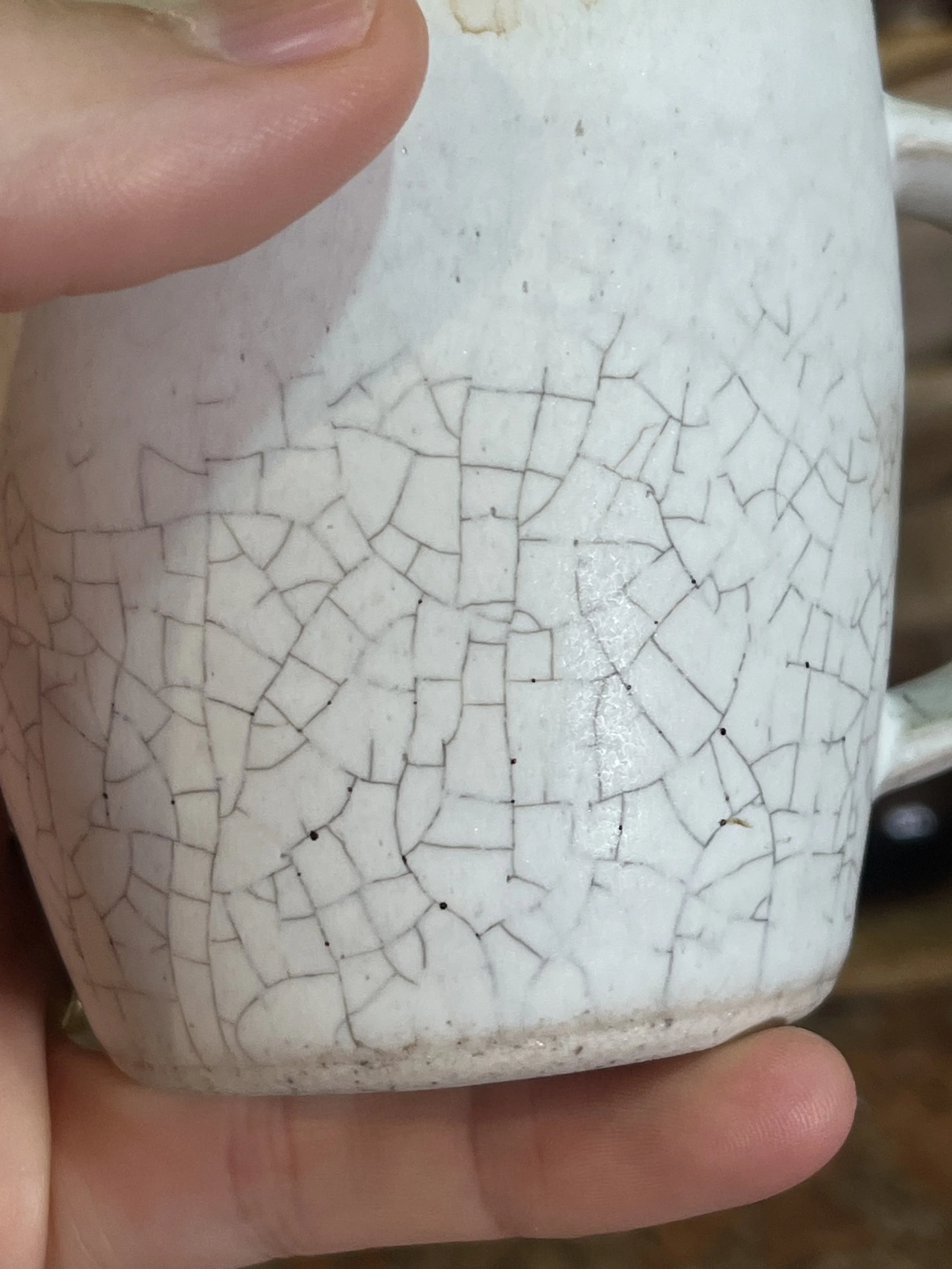
Here’s an example of what can happen with a high-absorption ceramic and a crazed glaze:
This mug shows coffee staining the network of crazing cracks on the outside of the mug, and forming small pinheads of coffee- because it has soaked all the way through the walls.
Note that when the cracks are not stained liquid, toward the top of the mug, they are much harder to see.